
The Technical Frontier of 8-Bit Law Enforcement
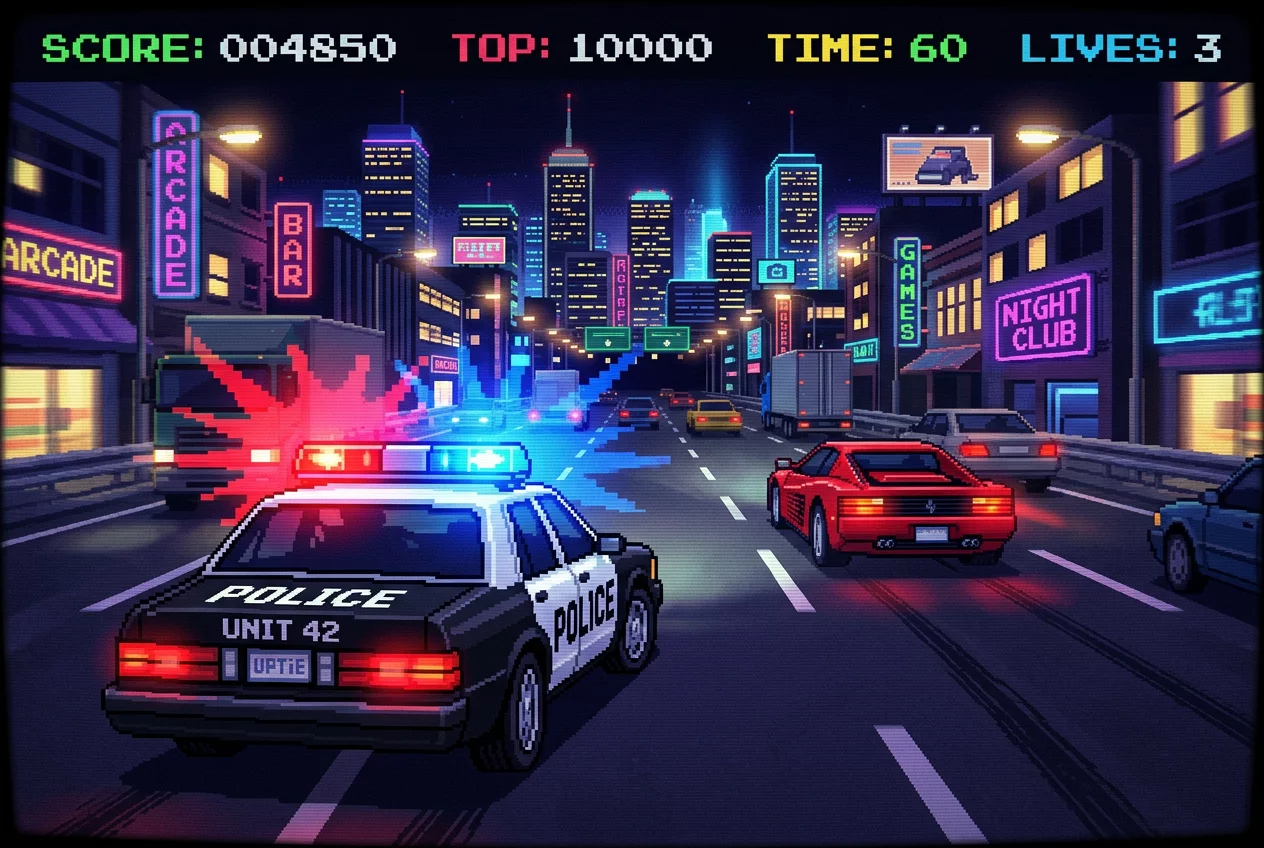
During the zenith of the Dendy's popularity, developers constantly sought ways to squeeze more performance out of the limited hardware. Pursuit-based arcade titles stood as a testament to this ingenuity. These games moved away from simple side-scrolling mechanics to embrace pseudo-3D perspectives that simulated the depth of a metropolitan highway. The visual design relied heavily on shifting palette colors and rhythmic sprite scaling to create a convincing sense of velocity. It was during this period that the 'crown' of arcade racing began to shift toward more complex simulations of urban environments, where the flickering of neon signs against a black pixelated sky defined the era's aesthetic.


Sonic Innovation and Visual Fidelity
Perhaps the most striking element of these pursuit titles was the integration of advanced audio techniques. While most 8-bit games relied on simple square waves, the pursuit genre experimented with rudimentary voice synthesis. Hearing a digitalized voice command through a CRT television speaker was a revolutionary experience for players accustomed to silent text boxes. This auditory feedback, combined with the intense flickering of red and blue light sprites, created an immersive atmosphere that paved the way for modern online high-speed simulations. The complexity of the sprite layering allowed for multiple vehicles to occupy the screen without significant slowdown, a feat of coding that remains impressive today.
- Implementation of pseudo-3D scaling for enhanced road depth and horizon positioning.
- Innovative use of voice synthesis for law enforcement commands and radio chatter.
- Dynamic lighting effects simulating emergency vehicle beacons through palette cycling.
Looking back, the pursuit genre on the Dendy wasn't just about speed; it was about the atmosphere. The technical constraints forced artists to be creative with limited assets, resulting in a distinct visual language of heavy shadows and bright, primary-colored highlights. These titles laid the foundation for the complex urban environments we see in today's digital landscapes. They proved that even with a handful of colors and minimal memory, it was possible to evoke a world of high-stakes tension and cinematic flair.
Historical Context FAQ
How was the pseudo-3D effect achieved?
Artists used sprite scaling and horizontal line shifting to create the illusion of a vanishing point on a flat 2D plane.
Why was voice synthesis so rare?
The memory required for digitized audio samples often exceeded the capacity of standard game cartridges, requiring special co-processors.

CopChaser
15/06/2026